


Banking & Financial Services
Transform planning with integrated, data-driven decision making
- connected planning
Build agility and performance across FP&A, operations and governance
The banking and financial services sector is operating under growing complexity. Rising capital requirements, regulatory scrutiny, customer expectations, and margin pressure are reshaping how decisions are made. To respond effectively, planning needs to be connected, reliable, transparent, and aligned to strategic objectives.
Retail & Business Banking: High Level Planning Processes
Zooss helps banks modernise planning across Finance, Risk, Treasury, Product and Operations - creating a planning environment that is scalable, governed, and built for continuous change.
There are four interconnected planning domains in banking and financial services organisations:
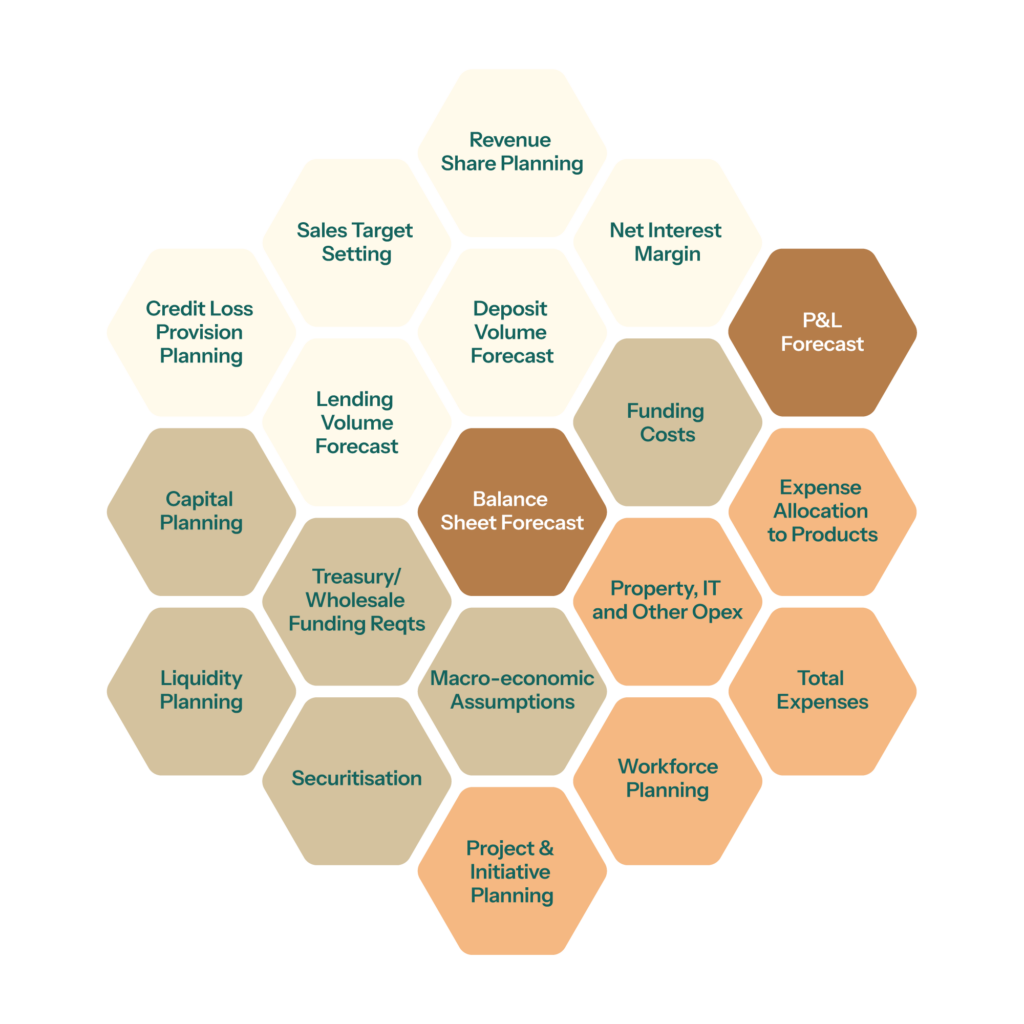
PRODUCT TEAM PLANNING
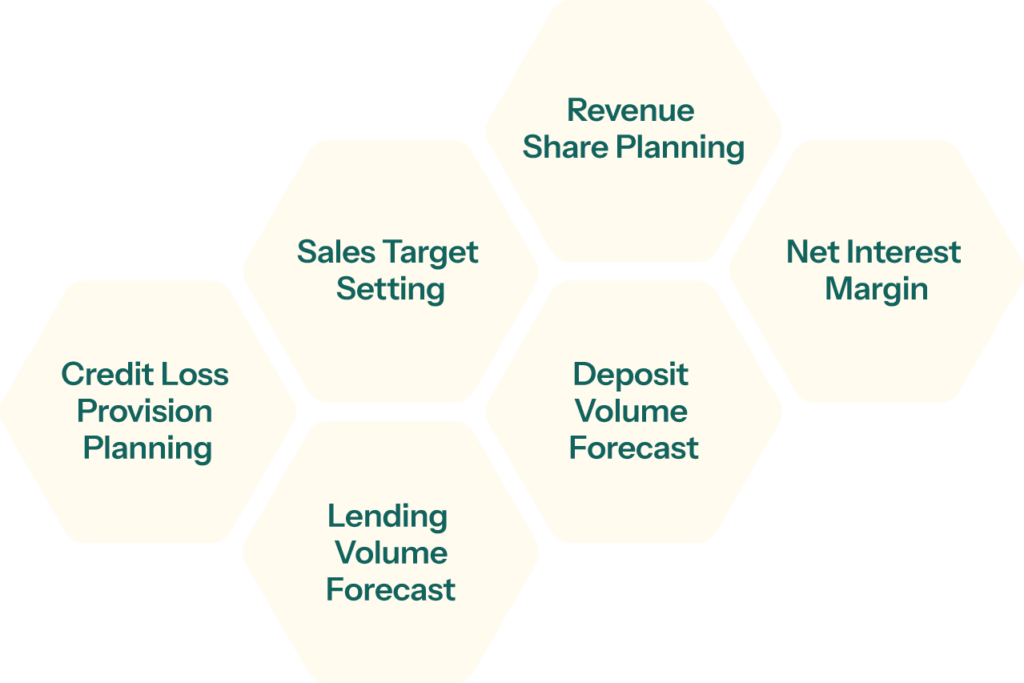
Sales Target Setting
Annual growth targets are set for lending and deposit volumes, informed by the bank’s strategic plan.
Lending Volume Forecast
The lending product teams (e.g. home loans, credit cards, business lending) reforecast volumes monthly using business drivers such as applications per day.
Deposit Volume Forecast
The deposit product teams (e.g. savings, transaction, term deposits) reforecast volumes monthly using business drivers such as churn and price elasticity.
Credit Loss Provision Planning
Once lending volume forecasts are finalised, provisions can be updated in line with risk modelling and IFRS9 requirements.
Revenue Share Planning
This covers both third-party revenue sharing (e.g. distribution/white labelling partners) and internal contra revenue where deposits are ‘borrowed’ between business units to help fund lending.
Net Interest Margin
Changes to client rates are planned to meet margin targets once the funding components of the NIM have been calculated by the treasury team.
TREASURY & FUNDING TEAM PLANNING
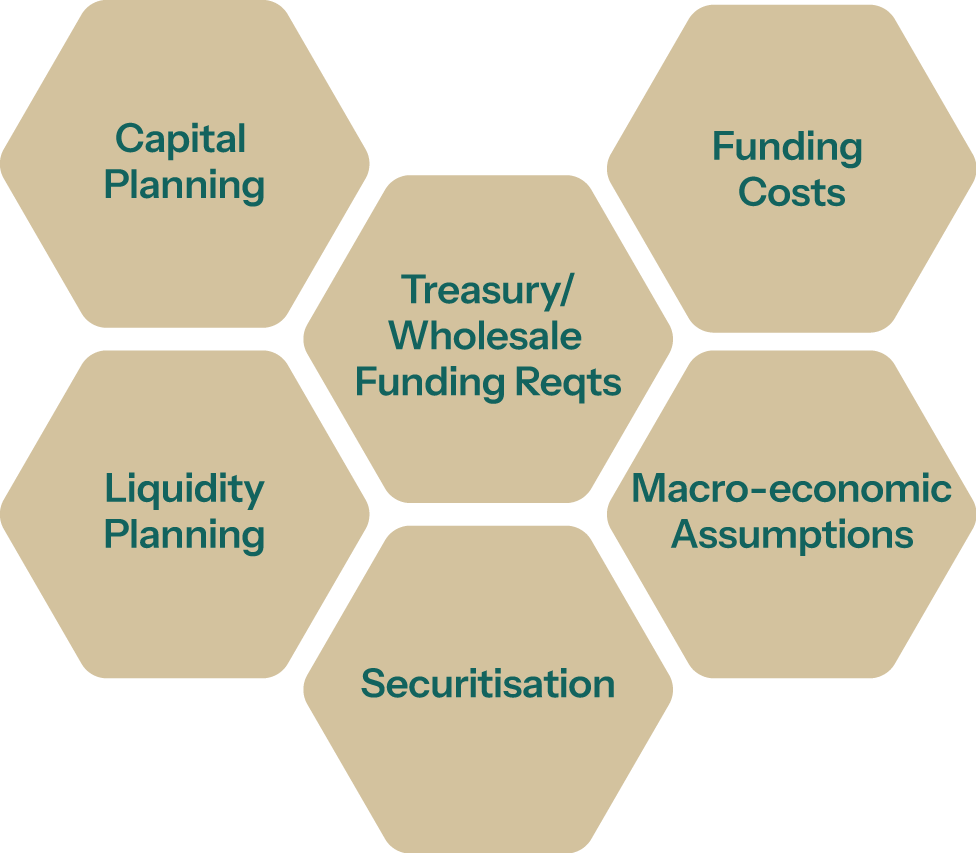
Securitisation
Once lending volume forecasts are finalised, some funding requirements may be met by issuing new securities backed by these lending assets.
Treasury/Wholesale Funding Requirements
The lending forecast needs to be fully funded, by:
- Useable deposits (from deposit volume forecast)
- Securitising lending assets, or
- Group Treasury or wholesale funding
Capital Planning & Funding Allocation
Funding is allocated back to products to meet their individual funding requirements, in accordance with capital adequacy requirements.
Liquidity Planning
Net cash outflows are modelled as a proportion of High Quality Liquid Assets to ensure appropriate coverage.
Macroeconomic Assumptions
The economics team provide macroeconomic assumptions to drive funding cost modelling.
Funding Costs
Each funding type is costed (including internal funding provided by deposits) and applied to each product NIM in accordance with the volume of funding they were allocated in the Capital Planning stage.
EXPENSE PLANNING
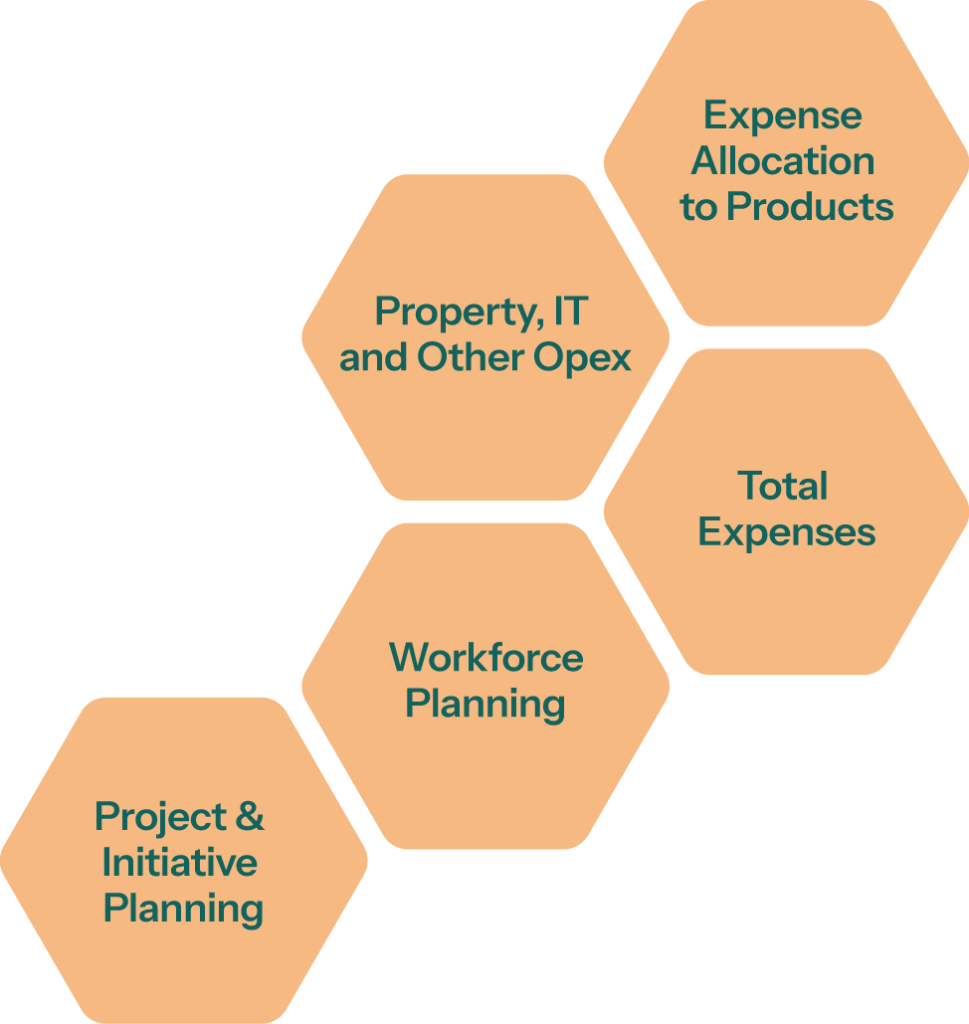
Project & Initiative Planning
Initiatives are prioritised based on strategic objectives and available staff/expense headroom.
Workforce Planning
Headcount-based forecasts are developed to take account of:
- Promotions, transfers and attrition
- Call centre volumes and other activity variables
- Initiative requirements
Property, IT & Other Opex Planning
Other opex lines are planned using appropriate drivers (e.g. floorspace/IT equipment per person) with one-off costs and overlays added.
Total Expenses
Expenses are consolidated and scenarios planned to ensure reasonableness of forecast.
Expense Allocation to Products
Expenses are then allocated to individual products based on:
- Direct allocations for dedicated teams (eg call centres)
- Activity splits for shared teams
- FUM or other relevant drivers
CONSOLIDATED REPORTING
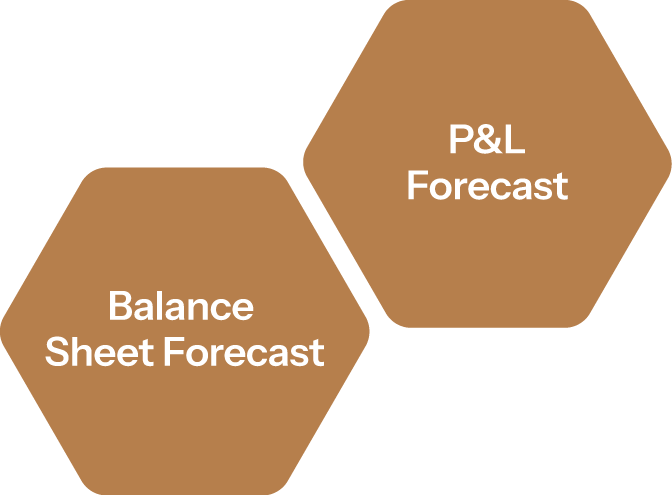
P&L forecast
Balance sheet forecast
Common challenges we solve for financial services customers
Banks and financial services organisations come to Zooss when they face challenges such as:
- Too much manual effort in reporting, forecasting and regulatory submissions
- Siloed planning across Finance, Risk, Treasury and Product teams
- Difficulty modelling scenarios quickly and accurately
- Complex product and account hierarchies that make reporting slow and inconsistent
These challenges slow decision-making and increase operational risk. We help organisations bring clarity, governance and confidence back into planning.
- how zooss helps
We design and implement planning solutions that connect data, models and workflows across the business
Our capabilities include:
- FP&A: budgeting, forecasting, rolling planning, profitability modelling
- Regulatory & Financial Reporting: automated, auditable reporting processes
- Risk & Capital Planning: scenario modelling, stress testing and liquidity planning
- Product & Portfolio Planning: pricing, margin and lifecycle analytics
Benefits we deliver:
- Reduced manual work and reporting effort
- Faster, scenario-based decision making
- Consistent, governed data across planning and reporting
- Clear auditability and traceability
- Greater alignment between Finance, Risk and the business
- why banks choose zooss
Our mission is to enable better business planning and reporting
- Deep experience in Australian financial services sector: from major banks to institutional lenders
- Strong data and architecture capability: we fix the data layer, not just the model
- Proven approach to change and adoption: we build capability, not dependency
- Global reach through GAIN: access to more than 300 connected planning specialists worldwide
Local experience, global reach
“For our customers, our worldwide network GAIN opens up access to each partner’s deep regional knowledge, industry specialisation, and best-in-class Anaplan expertise – ensuring smooth, consistent implementation to businesses operating across multiple regions.”
Steve Bows
Managing Director, Zooss Consulting
Uniting people, data, and decisions
The next competitive advantage in banking will come from planning transformation – bringing people, data, and decisions together across finance, risk, and operations.
Zooss helps financial institutions achieve that transformation by connecting financial performance to purpose, and growth to governance – creating clarity, trust, and agility in every planning process.